

The decision to build a custom home rather than buy an existing one is, at its core, a decision to start from intention rather than compromise. It is the choice to have the layout that reflects how your household lives, the materials that meet your standards, the site relationship to light, landscape, and to neighboring properties that a resale home in a fully built-out neighborhood can rarely offer. It is a significant commitment, and for the homeowners who make it thoughtfully, the result is a home that performs at a level an existing house cannot match.
What that decision does not guarantee, on its own, is a lot that will support the home you have in mind.
In Loudoun County and Fairfax County — the two markets where Metro Design Build Group does most of its custom home building — the gap between a lot that looks promising on a listing sheet and one that is genuinely buildable for the home you intend to build can be significant. Zoning classifications, setback requirements, environmental constraints, utility access, soil conditions, and recorded easements all shape what can be built, where it can sit on the parcel, and what it will cost to prepare the site. None of these factors appear on the listing. All of them matter. Homeowners who navigate this process most successfully are the ones who engage with these questions before they make an offer, not after. So, let’s look at the framework Metro uses when working with clients who are evaluating land.
What the Listing Tells You, and What It Does Not
A land listing describes acreage, location, and price. It may note zoning classification and whether public utilities are available. In the best cases, it includes a land survey. What it does not describe is the full picture of what can be built on the property and what it will take to build it.

Fairfax County draws a distinction that is worth understanding precisely: a lot can be legally valid without being buildable. Validity means the parcel exists as a recorded subdivision lot with clear title. Buildability means the parcel can accommodate a structure that satisfies minimum yard requirements, floodplain restrictions, Chesapeake Bay Preservation rules, stormwater requirements, and erosion controls, and does so with a building envelope large enough to contain the home you intend to build.
The two do not always coincide, and the gap between them is where custom home projects most often encounter their most expensive surprises.
The due diligence that precedes a land purchase is not a formality. It is the research that determines whether the vision for a custom home is achievable on a specific parcel at a budget that makes sense or whether that vision needs a different lot.
Zoning: The Rules That Govern What Gets Built
Every parcel in Loudoun County and Fairfax County sits within a zoning district that establishes the permitted uses of the land, the density of development allowed, the minimum lot size required, and the setbacks that determine how close a structure can come to property lines, roads, streams, and other features. Understanding the zoning classification of a parcel is the first and most fundamental step in land evaluation.
Fairfax County
Fairfax County’s residential zoning districts range from R-1 through R-8, with each designation carrying different lot size minimums and development standards. In communities like Great Falls and the more rural portions of western Fairfax County, R-1 and R-2 zoning governs much of the developable land, with minimum lot sizes of one and two acres respectively and setback requirements that can substantially reduce the building envelope on a parcel that looks generous on paper. Corner lots, irregularly shaped parcels, and properties with easements running through them frequently have building envelopes considerably smaller than their listed acreage suggests.
Front-yard paved coverage is also capped on certain Fairfax County single-family lots — a constraint that affects driveway design and can matter considerably for properties where a circular drive or expanded motor court is part of the program. This is the kind of detail that does not surface until a site plan is drawn, and it is far better to know it before committing to a design than to discover it during the permitting review.
Loudon County
Loudoun County’s zoning picture is more varied, reflecting the county’s character as a landscape in transition between suburban Ashburn and Leesburg in the east and the rural agricultural communities of the western county. For custom home projects in the western county where estate lots, equestrian properties, and wooded parcels that attract a certain buyer, the relevant zoning districts are primarily AR-1 and AR-2, which carry minimum parcel sizes of twenty and ten acres respectively for new subdivision and impose specific restrictions on impervious surface, ridgeline building, and density. A parcel in the AR-1 or AR-2 district is not simply a large lot with room to build. It is a rural parcel with a regulatory framework designed to preserve agricultural character and limit development intensity, and understanding what that framework permits before a design is commissioned is the difference between a project that moves forward on schedule and one that requires significant redesign after a zoning review.

Setbacks, Easements, and the Building Envelope
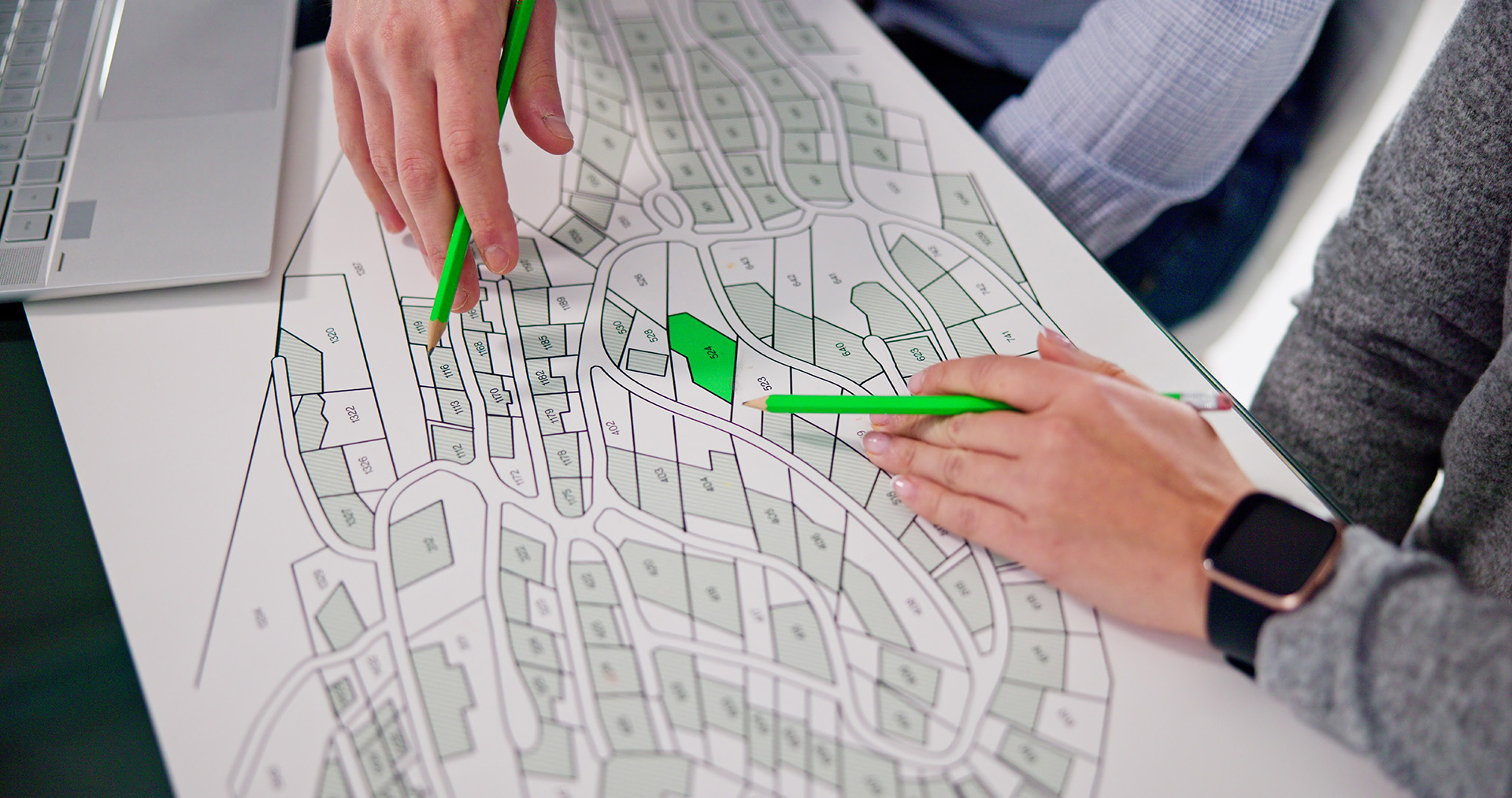
The building envelope is the area of a parcel within which a structure may be constructed, once all setbacks, easements, and environmental buffers are accounted for. It is almost always smaller (sometimes significantly smaller) than the parcel itself and understanding its actual dimensions before designing a home for the lot is one of the most important steps in the land evaluation process.
Setbacks in Fairfax County and Loudoun County vary by zoning district and by the specific conditions of the parcel. Front, rear, and side yard minimums establish the perimeter of the building envelope. Stream buffers add additional setback requirements adjacent to waterways and in Chesapeake Bay Preservation areas, which cover a significant portion of both counties’ watersheds, those buffers can extend considerably further than the basic zoning setbacks. Floodplain restrictions, which in Fairfax County apply to three distinct categories of floodplain — minor, major, and FEMA-designated — further constrain what can be built in low-lying areas adjacent to streams and wetlands.
Easements recorded against a property for utilities, drainage, access, or conservation purposes are a separate category of constraint that often has nothing to do with zoning and everything to do with what can physically be built where. Fairfax County is explicit that structures may not encroach into recorded easements, and on some parcels, easement corridors running across the property can eliminate what would otherwise appear to be a logical building site. Reviewing recorded easements is a step that buyers who work without experienced professional support frequently miss.
Utilities: The Question That Determines Site Development Cost
Whether a parcel is served by public water and sewer or requires private systems is among the most consequential practical questions in land evaluation, and the answer is not always obvious from location alone. In eastern Loudoun County and the closer-in portions of Fairfax County, parcels are generally served by public systems. Keep in mind, however, that connection fees and the cost of extending service across a larger parcel can add significantly to the site development budget. In Great Falls, Clifton, and across the rural western portions of both counties, private wells and onsite septic systems are the norm.
Private Well and Septic
The percolation test determines whether the soil can absorb wastewater at a rate sufficient for an onsite septic system sized for the intended home. In Loudoun County, a Sewage Disposal Permit from the Virginia Department of Health, based on a perc test conducted by a licensed Onsite Soil Evaluator or Professional Engineer, is a gating requirement before the county will issue a building permit. Parcels that fail the perc test or that pass only for a smaller system than the home requires, have a fundamental constraint on what can be built. Well yield is similarly site-specific and cannot be predicted with certainty before drilling. The combined cost of well, septic, driveway construction, and electrical service extension on a rural Loudoun parcel routinely runs from $150,000 to $400,000 or more before the foundation is poured. These expenses are essential to the project budget and are not reflected in the listing price.
Topography, Soil, and What Lies Beneath
The physical character of a parcel — its topography, drainage patterns, and tree cover — shapes both the design of the home and the cost of preparing the site. A steeply sloped lot in Great Falls or western Loudoun may offer dramatic views and wooded privacy while also requiring significant grading, retaining structures, and engineered stormwater management. Chesapeake Bay Act compliance, which applies to development across much of both counties’ watersheds, requires engineered stormwater plans on most rural parcels. Ridgeline and mountainside overlay districts in parts of western Loudoun add additional restrictions on grading and visible development that must be incorporated into the design from the outset, not addressed after a site plan is already drawn.

Soil bearing capacity varies considerably across the region. The clay-dominant soils common in Fairfax County and much of Loudoun County require specific foundation engineering in many cases, and Piedmont geology in the western county introduces bedrock at varying depths that can affect both foundation design and septic system installation costs. A geotechnical investigation is not always required before a permit is issued, but on a parcel where foundation conditions are uncertain, it is almost always worth commissioning before a design is finalized.
Why Bringing in a Builder Before You Buy Is Not Premature — It Is Prudent
The conventional sequence for a custom home project — buy the land, then engage a builder — is understandable as a sequence of commitments, but it is not the most effective sequence for making a sound decision. The questions that determine whether a lot is the right lot for a specific home program are questions that an experienced builder is better positioned to evaluate than a buyer acting alone, a real estate attorney, or even a licensed surveyor working in isolation.
What a builder brings to a land evaluation is the integration of site conditions with design and construction reality. A parcel with a specific setback configuration may accommodate a 6,000-square-foot home oriented in one direction and not in another. A sloped lot may support a walkout lower level that adds square footage without adding footprint, or it may require a foundation system that adds meaningful cost to the project. A site with mature trees may dictate a building location that a buyer has not anticipated. These are not findings that a listing review produces. They are findings that a builder makes by walking the site, reviewing the surveys, and thinking about the parcel in terms of what can actually be built on it.
At Metro Design Build Group, we regularly work with prospective custom home clients at the land evaluation stage, before a purchase contract is signed. We review available survey data, walk parcels with clients, and provide an honest assessment of what a specific lot can support, what site development is likely to cost, and whether the home program the client has in mind is achievable within the lot’s constraints. This is not a commitment to build. It is the kind of informed counsel that makes the decision to buy — or not to buy — a confident one.
We have built custom homes in Loudoun County, Fairfax County, and across the DC Metro area. We understand the regulatory landscape in both markets and the site-specific variables that determine whether a lot and a home program are genuinely compatible. If you are evaluating land or considering a custom home project and want to understand where to begin, we would welcome the conversation.