

In an article we posted last year about 2025 kitchen trends, the kitchen design conversation was dominated by personality and warmth. Sage green cabinets brought nature indoors. Expansive islands redefined how families gather. Bold backsplashes and textured finishes pushed kitchens away from clinical minimalism and toward something richer and more layered.
In 2026, that trajectory continues — but it has evolved. Where 2025 was about introducing warmth, 2026 is about refinement. The moves are more measured. The material choices are more intentional. The kitchen is evolving not just in style, but in purpose as homeowners across Northern Virginia, Washington, DC, and Montgomery County increasingly expect their kitchens to perform as beautifully as they look.
Here are the fifteen kitchen design trends shaping kitchen remodels in the DC metro area this year.
1. Aged And Patinated Finishes
In 2025, unlacquered brass made a strong entrance. In 2026, the concept deepens. Homeowners are gravitating toward finishes on hardware, fixtures, range hoods, and cabinetry that suggest age and authenticity rather than newness. Antique bronze. Oxidized copper. Hand-forged iron. These are materials chosen because they will look better in ten years than they do today, which is precisely the philosophy that suits an older Colonial in McLean or a craftsman bungalow in Falls Church.
2. Unfitted Kitchen Design
The fully fitted kitchen has been the dominant model in luxury residential design for two decades. In 2026, the most interesting kitchens are pushing back. Unfitted kitchens incorporate freestanding furniture pieces like a hutch, an antique worktable, or open shelving that reads as collected rather than installed, alongside traditional cabinetry. The result feels less like a designed room and more like one that has evolved over time, an aesthetic that sits beautifully in the historic homes of Georgetown, Old Town Alexandria, and the established neighborhoods of Bethesda and Potomac.
3. Tadelakt And Limewash Plaster Surfaces
In 2025, texture arrived primarily through cabinet choices such as fluted wood, ribbed glass, and honed stone. In 2026, texture is moving to the walls. Tadelakt (a Moroccan lime-based plaster, renowned for its waterproof, seamless, and luxurious glossy finish) and hand-applied lime putty finishes bring an organic, artisanal quality to a kitchen that no paint can approximate, and they age with exceptional beauty. In the DC metro area’s luxury communities, where the preference for materials that develop character over time is well established, plaster wall treatments are one of the most distinctive choices a kitchen designer can make this year.
4. The Scullery Returns
We noted the rise of walk-in pantries and back kitchens in our 2025 trend overview. In 2026, that concept has a sharper definition. The scullery is a dedicated working kitchen positioned adjacent to the primary kitchen and housing the prep mess, overflow appliances, and secondary sink that allows the main kitchen to remain composed and beautiful regardless of what is happening behind the scenes. In the larger homes of Great Falls, McLean, and Potomac, this is increasingly a standard expectation rather than an aspirational feature.
5. Warm, Dark Cabinet Colors — Beyond Green
Sage green had its moment, and it was well deserved. In 2026, the color conversation is moving deeper and warmer. Forest Green anchors a room with conviction rather than whimsy. Deep plum and aubergine are appearing in primary kitchens in ways that feel entirely natural today. Warm black — not the cool graphic black of the mid-2010s, but a black with undertones of brown and umber — is replacing navy as the bold choice that also reads as sophisticated. What connects these colors is their relationship to depth. The 2026 kitchen is not afraid of shadow.
6. Stone Everywhere
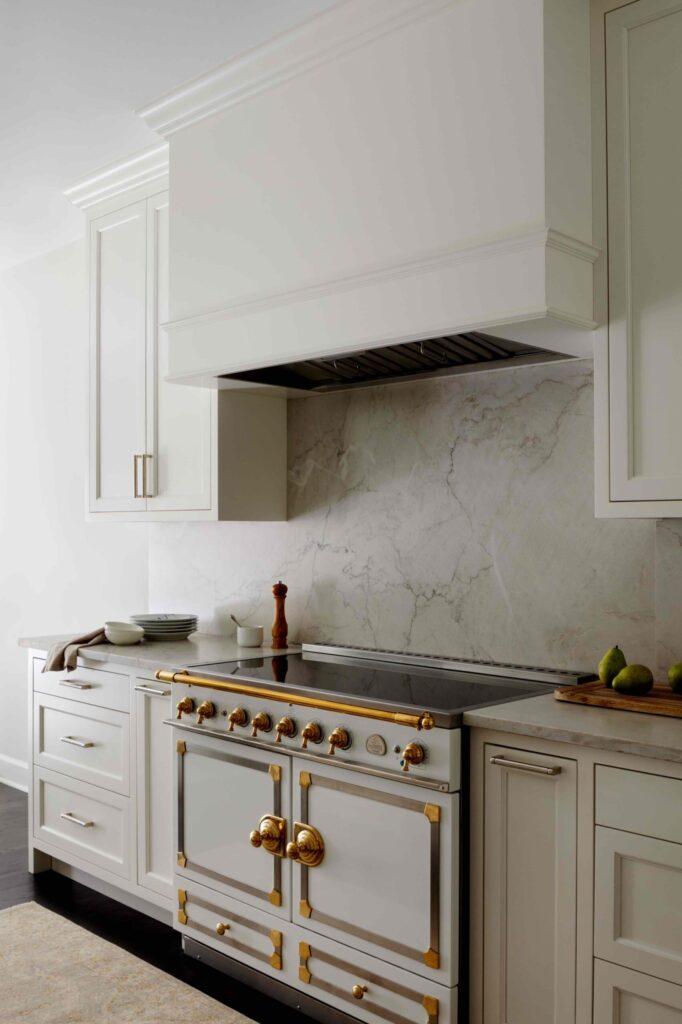
Quartzite emerged as a countertop material of note in 2025. In 2026, natural stone is no longer confined to the countertop. The most compelling kitchen remodels in the DC metro area are extending stone to the backsplash, the range surround, the island base, and in some cases the floor. This creates a geological coherence that no tile combination can achieve. Full slab backsplashes are now being matched to island waterfall edges, so the veining reads as continuous across the room.
7. Integrated and Invisible Ventilation
Statement range hoods had a strong 2025. That direction has not disappeared, but it has a counterpart in 2026: the invisible hood. Downdraft systems that retract into the countertop. Ceiling-mounted ventilation integrated into a structural beam. Hood liners concealed within cabinetry so that ventilation becomes a function rather than a form. Homeowners who want the kitchen to read as seamlessly as possible are choosing concealment. Those who want a strong architectural moment at the range wall are continuing to invest in custom hood design. Both are valid and both are more available than ever.
8. Curved And Organic Forms
The sharp corner is softening in 2026. Curved islands are replacing rectangular ones where the layout permits, creating more fluid traffic flow and a more inviting silhouette. Arched cabinet details, rounded island ends, and organic countertop profiles are introducing movement and ease that strictly rectilinear design cannot provide. This connects to a broader shift in interior design toward softness and the organic — a direction that feels particularly at home in older houses where period detailing already introduces non-rectilinear form into the design vocabulary.
9. The Two-Toned Kitchen Evolves
Two-toned cabinetry was a 2025 staple. In 2026, the idea is being refined. The distinction is no longer simply upper versus lower cabinets. Islands are being treated as a third design element with their own material and finish logic. Accent cabinetry like a wall of open shelving in a contrasting wood tone, or a china cabinet integrated into the kitchen composition, introduces yet another layer. The best results feel collected and curated rather than configured, as if the kitchen accumulated the right pieces over time rather than arrived at a two-tone decision.
10. Cooking as a Design Statement
In 2025, the trend in appliances was largely about concealment. In 2026, a countertrend is asserting itself: the deliberate elevation of cooking as a design centerpiece. A 48-inch professional range in a deep jewel tone, framed by custom millwork or handmade tile, becomes the room’s focal point in a way that no concealed appliance ever could. For homeowners in the DC metro area’s luxury communities who entertain regularly and cook seriously, this is one of the most rewarding investments a kitchen remodel can make.

11. Item Specific Storage Solutions
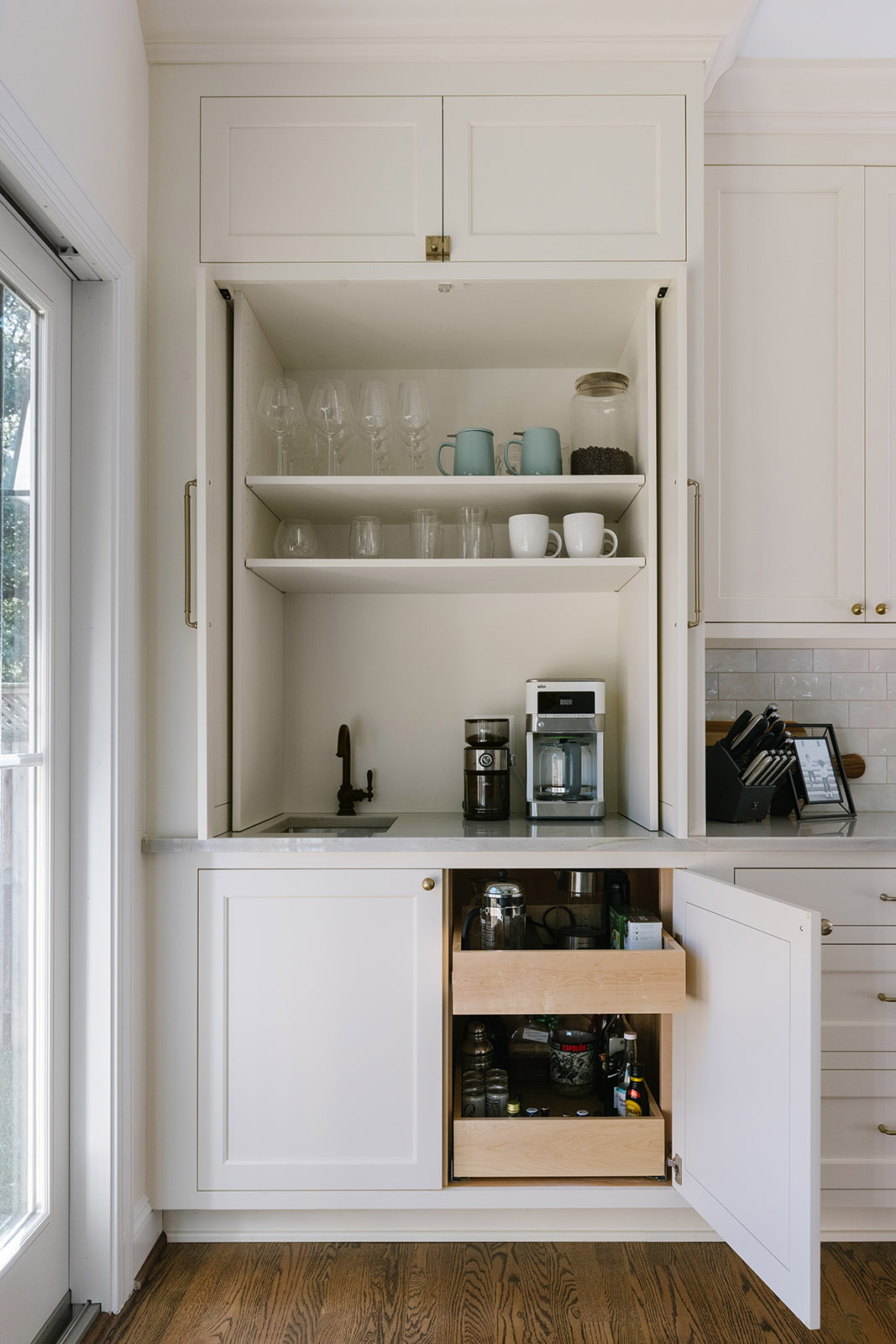
What is changing in 2026 is the specificity with which storage is being designed. Rather than specifying a pantry cabinet with standard shelving, remodels are being designed around the exact inventory of the household, like the dimensions of the stand mixer, the number of sheet pans, the knife collection that deserves better than a block on the counter. This level of custom storage thinking requires early and detailed design conversations, and it produces kitchens that function with an efficiency no standard configuration can match.
12. Natural Light — Engineered and Amplified
The desire for natural light is not new. What is changing is the sophistication with which it is being addressed. Skylights with solar-tracking louvers. Pass-through windows between kitchen and outdoor entertaining areas. Interior openings between the kitchen and adjacent rooms that borrow light from spaces with better exposure. In the DC metro area, where older homes often position the kitchen away from the best sun orientation to keep the room cooler, these strategies are among the most impactful changes a renovation can make.
13. The Return of the Breakfast Room
As open-plan living has matured, a quiet countertrend has appeared: the recognition that not all domestic life benefits from a single undifferentiated space. The breakfast room — a dedicated casual dining area next to the kitchen, distinct from both the formal dining room and the island — is reappearing in DC metro area remodels with more frequency. In older homes, this often means restoring a morning room that was absorbed into an open kitchen in an earlier renovation. The result is a space that feels intimate and specific in a way that a few stools at an island never quite does.
14. Intentional Technology Integration
In 2025, smart kitchen features were presented as conveniences. In 2026, the conversation has shifted from what technology can do to how it should be incorporated so that it serves the kitchen rather than competing with it. Induction cooktops that disappear into stone countertops. Refrigeration drawers integrated into the island. Charging surfaces that look like countertop material until a device is placed on them. The goal is a kitchen that functions with contemporary intelligence without announcing its technology at every turn.
15. Handcrafted Details as the Defining Luxury
If there is a single line connecting the most significant kitchen design trends of 2026, it is craftmanship. Not the manufactured suggestion of it, but the genuine article. Handmade ceramic tile from a small studio. A range hood shaped by a metalsmith. Custom hardware cast by an artisan. Open shelving built from salvaged walnut by a local woodworker. In the Washington, DC metro area’s luxury communities, where the homes themselves are often the product of generations of skilled craft, this instinct toward the genuinely handmade feels deeply appropriate and is deeply enduring.

What 2026 Is Telling Us
Taken together, these trends describe a kitchen design landscape moving steadily toward specificity, authenticity, and permanence. The most thoughtful remodels across Northern Virginia, Washington, DC, and Montgomery County this year are not trend-responsive in the way that kitchen design has sometimes been. They are principle-responsive, meaning, driven by a clear understanding of how the household lives, what the home’s architecture calls for, and what materials and details will age with the grace that makes a kitchen feel better at twenty years than it did at two.
That is the standard Metro Design Build Group has always applied. Not what is current, but what is right — for the home, for the family, and for the long relationship between the two.
Ready to design a kitchen that reflects how you live — and how you want to live? Let’s begin with a conversation.